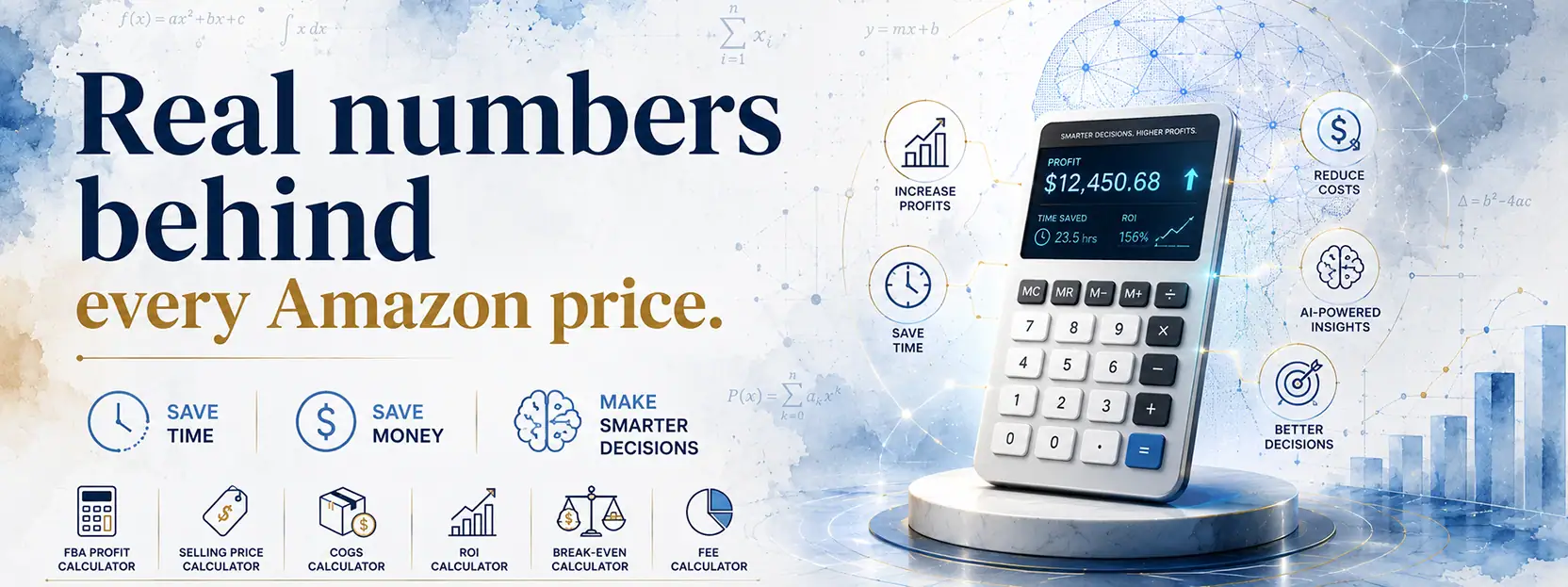


Understand what you're really paying — and whether that "deal" is actually a deal.

Know your margin before you list. Fees, ad breakeven, and listing tools built for real decisions.
Free · Private · No signup
Five calculators for sellers and shoppers — FBA fees, ad breakeven, inventory payback, unit pricing and cost per use. Everything runs on your device. Nothing is ever uploaded.
Worth knowing
Amazon's referral fee is calculated on item price plus shipping and gift wrap — not just the listed price. Free shipping doesn't make the fee disappear, it just moves it.
When a customer returns an item, Amazon refunds part of the referral fee — but keeps a refund administration fee. High-return categories feel this the most.
The same product can sometimes sit in two valid categories with different referral rates. A few percentage points on every unit adds up fast at volume.
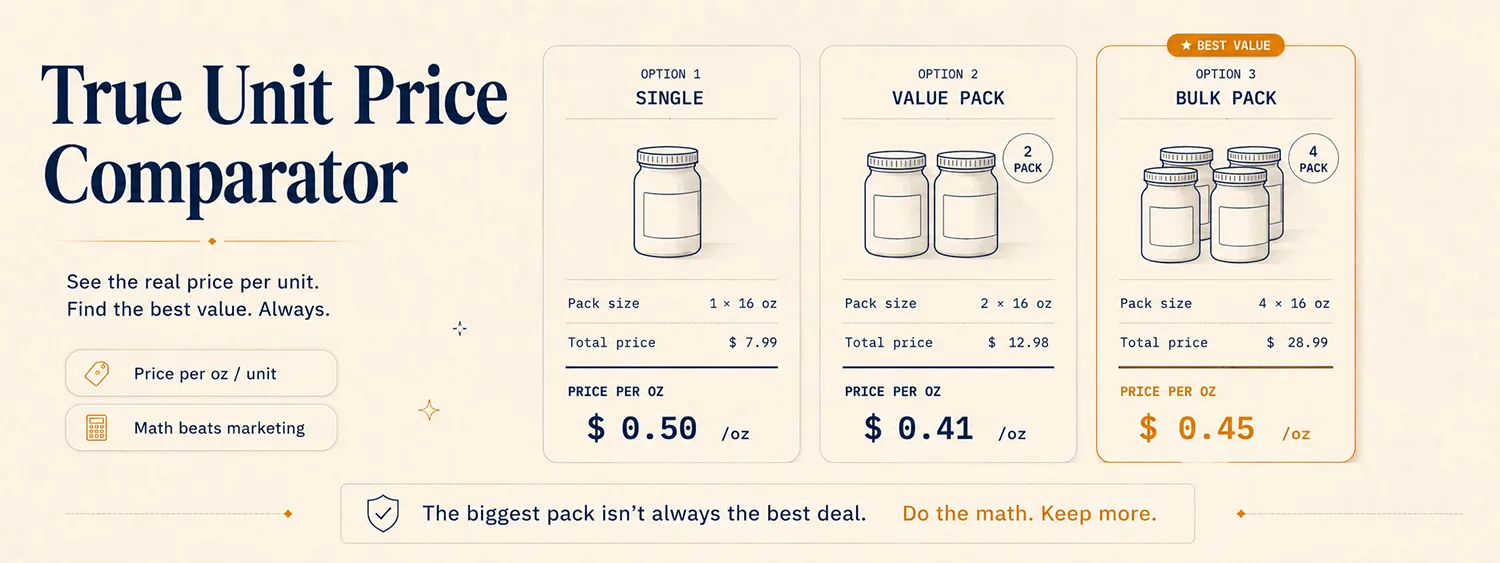
"Value" multipacks often have a worse per-unit price than the single item once you do the math. Always compare price per ounce, not price per package.
All six tools
Click any tool to see exactly what it calculates, who it's for, and the specific problem it solves.
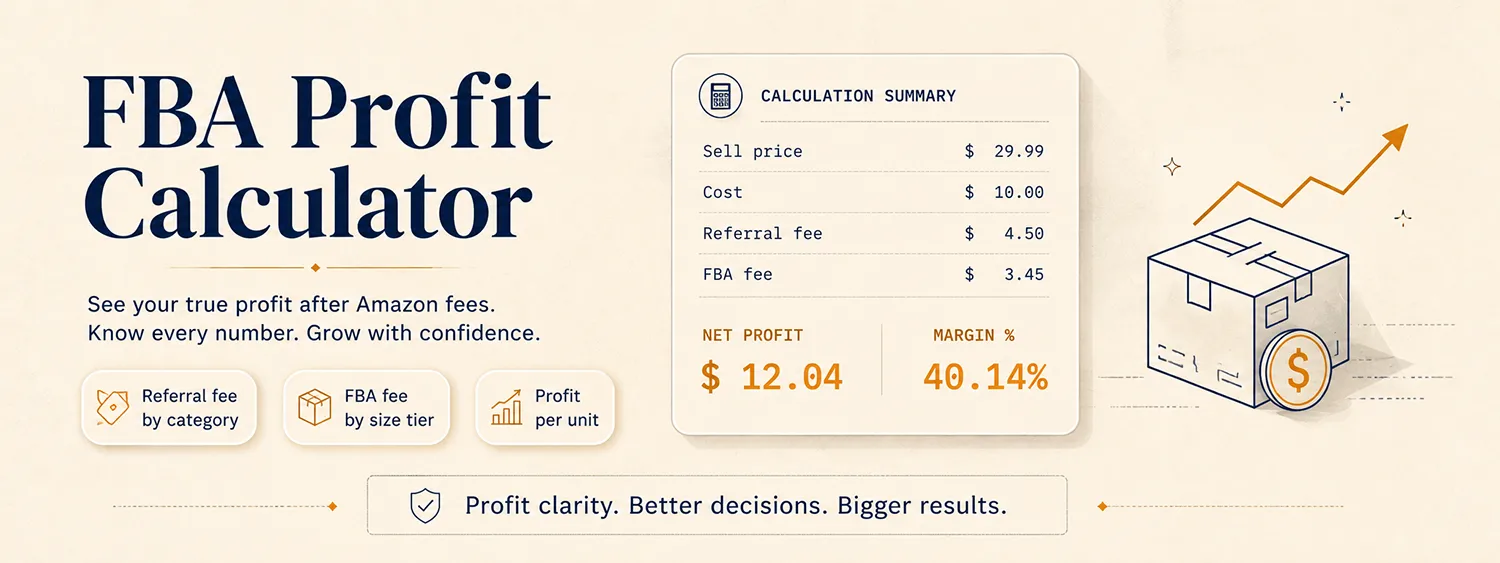
Enter your sell price, product cost, category, and dimensions. The calculator subtracts Amazon's referral fee and FBA fulfillment fee and shows your real profit and margin per unit — before you commit to inventory.
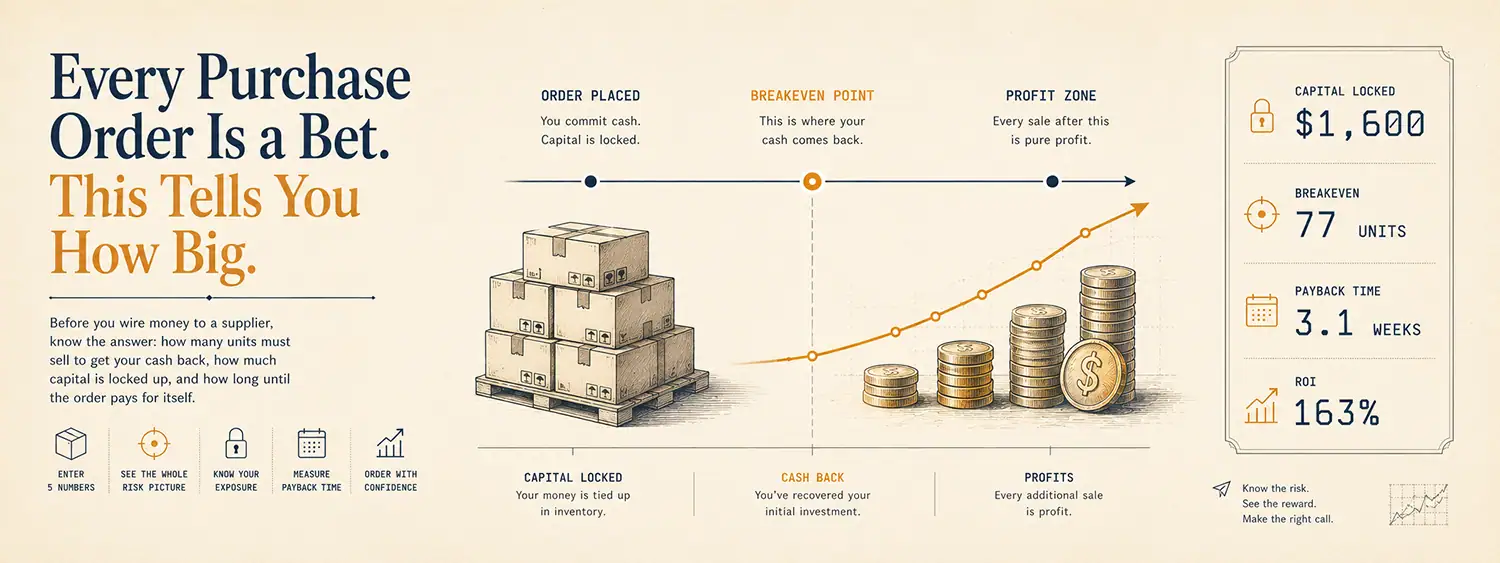
Enter your price, cost, fees and order quantity. The calculator shows how many units you must sell to recover your entire purchase order — plus the capital tied up, time to payback and full sell-through ROI.
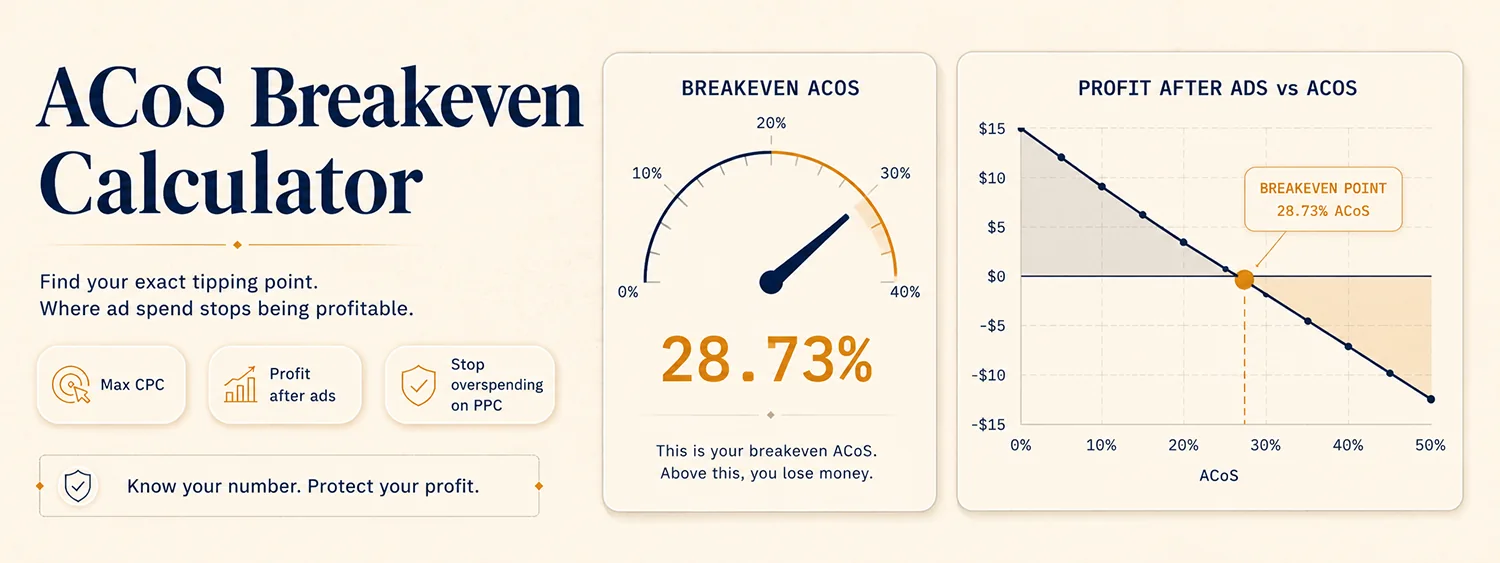
Enter your sell price, cost, and fees. The calculator returns the exact ACoS percentage at which your PPC campaigns stop making money. Spend above that number and every ad click costs you margin.
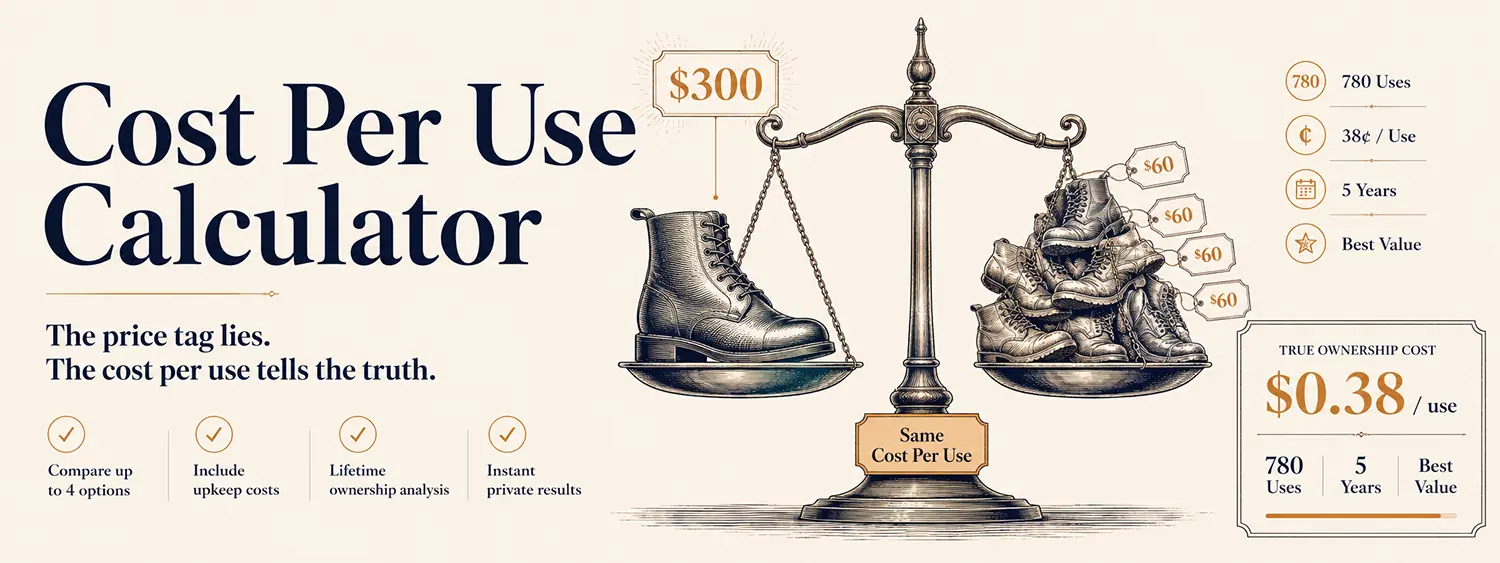
Compare what products really cost over their lifetime — price (plus upkeep) divided by how many times you'll actually use them. The $300 boots are often cheaper than the $60 ones once you do the math.
Compare 2–3 product options side by side. Enter the price and quantity (ounces, count, etc.) for each — see the real price per unit instantly. The "value pack" is often not the value.
Paste an order email and it auto-fills the details. Applies each retailer's real return window (including the Amazon/Walmart holiday extension), shows the capital locked in returnable items, and exports two calendar reminders per item.
Most of what Amazon sellers pay $29–$49 a month for — fee calculators, listing checkers, breakeven math — is arithmetic, not data. We built it once as a set of small, focused tools that run entirely as code in your browser. There's no server storing your numbers, no account to create, and no reason to ever charge for it. If a calculator here saves you a subscription, that's the whole point.
Every sale on Amazon involves at least two fees: a referral fee (a percentage of the sale price, varying by category — typically 8–15%, with a $0.30 minimum per unit) and, if you use Fulfillment by Amazon, an FBA fulfillment fee based on the item's size tier and weight. Sellers who only look at their sell price often discover their real margin is far thinner once both fees are subtracted.
The fastest way to know where you stand: enter your sell price and cost into the FBA Profit Calculator and see your margin instantly. If you're running ads, pair that with the ACoS Breakeven Calculator to find the maximum ad spend that still leaves you profitable.
Learn more →
Spending well on Amazon comes down to a few habits. Before assuming a bigger pack is the better deal, run it through the Unit Price Comparator — packaging size often hides the real price per ounce or per item. For durable goods, the Cost Per Use Calculator shows why the expensive option is frequently cheaper over its lifetime — sometimes a $300 item beats a $60 one once you count every use.
Shop smarter →
| Feature | Herminox.com | Typical paid tool |
|---|---|---|
| FBA fee & profit calculator | Free | $29–49/mo |
| Inventory payback & cash-flow calculator | Free | Often not included |
| Account required | No | Yes |
| Your data leaves your device | Never | Usually |
The most common FBA mistake isn't choosing the wrong product — it's running the margin calculation with only one of Amazon's three fees in the model. Sellers who discover the gap usually discover it on their first Seller Central payout statement, after the inventory has already landed.
The first layer is the referral fee: Amazon's commission, charged as a percentage of the selling price the moment a sale clears. Rates run from 8% on Consumer Electronics to 45% on device accessories, with 15% covering the majority of general merchandise. Seven categories — Apparel, Baby, Furniture, Grocery, Jewelry, Shoes, Watches — use tiered schedules that apply different rates to different price bands. A $14.99 t-shirt in Apparel pays 5% on the first $15: effectively 5% total. A $22 t-shirt pays 5% on the first $15 plus 10% on the next $7, not a flat 17%. A flat-rate estimate on tiered categories is never accurate, and the error compounds at volume.
The second layer is the FBA fulfillment fee: Amazon picks, packs, and ships for a flat per-unit rate set by size tier and weight band. Under the January 15, 2026 rate card, a standard small item under one pound runs $3.06–$3.56. A standard large item above three pounds runs $5.00–$7.00. Bulky and oversize tiers add a per-pound charge above the first pound. The fee schedule strongly rewards compact, lightweight products — and makes marginal items look profitable until you weigh the actual packaged unit.
The third layer, active since April 17, 2026, is a 3.5% fuel and logistics surcharge on the fulfillment fee. On a $4.60 fulfillment fee that is $0.16; on a $7.00 fee it is $0.245. Small per unit, significant at scale: on a 1,000-unit run, the surcharge alone adds $160–$245 in cost that was not in most sourcing models a year ago.
Subtract all three from your sell price, subtract landed cost, and what remains is actual profit. The FBA Profit Calculator models all three layers with the correct tiered and weight logic, returns net profit and margin in real time, and takes under ten seconds to run. If the result is under 20% before advertising spend, the product needs a different price, a lighter package, or a different category before it makes financial sense to list.
Run the FBA calculator →Amazon's search results are sorted by relevance and conversion rate, not by value. A 48-count pack sits next to a 6-count pack, both showing a price, neither showing a price per sheet. A $60 pair of shoes sits next to a $220 pair, with nothing on the listing explaining that one outlasts the other by a factor of four and ends up costing half as much per wear. The platform is designed to close sales quickly, not to help you compare carefully. The gap between what is shown and what matters is exactly where buyers consistently overpay.
The price-per-unit problem affects almost every consumable category on Amazon. Coffee, cleaning supplies, supplements, paper goods, pet food — all sold in multiple pack sizes, all priced as a total rather than a unit rate. The True Unit Price Comparator takes two or three products, their prices, and their quantities (ounces, count, weight), and returns a standardized price per unit. In repeated tests across categories, the cheapest listed item is the cheapest per-unit item only about half the time. The other half, a middle or higher listed price is the actual better deal once the pack size difference is removed from the equation.
The cost-per-use problem is subtler and applies to every durable purchase — shoes, luggage, kitchen appliances, tools, furniture, electronics. A $60 item used 30 times costs $2.00 per use. A $220 item used 200 times costs $1.10 per use and is often more repairable and comfortable. The Cost Per Use Calculator compares up to four options across their full lifetime, factoring in upkeep costs, so the value picture is complete before you buy.
The return-window problem is the most time-sensitive. Return deadlines vary by retailer, product category, and whether the purchase was made during a holiday window. Holiday purchases at Amazon and Walmart made between November 1 and December 31 typically extend to January 31 — a policy buried in fine print that most shoppers never read until the deadline passes. The Smart Return & Capital Dashboard tracks each item, applies the correct retailer policy including holiday extensions, shows the capital locked in returnable items, and exports calendar reminders. One missed return on a $200 item costs more than the thirty seconds it takes to run the tracker.
Herminox calculators are arithmetic engines, not data scrapers. They do not connect to Amazon's API, pull listing data, or estimate based on similar products. Every fee rate is hand-coded from Amazon's published US documentation, reviewed when Amazon updates its schedule, and cross-checked against known real-world orders before any change ships to the site.
The referral fee logic covers 30+ product categories with correct handling of both flat-rate categories (a single percentage applied to the full price) and the seven tiered categories where the rate changes at specific price thresholds. Applying the wrong model — a flat rate to a tiered category — overstates the referral fee by 10–30% depending on the item price. The calculator applies each band to the correct price slice, which is the only way to produce an accurate result.
The FBA fulfillment fee logic uses Amazon's 2026 rate card (effective January 15, 2026), maps packaged shipping weight to size tier, and maps tier plus sell price to the correct per-unit fee. The 3.5% fuel and logistics surcharge is a separate toggle, on by default because it has applied to every FBA unit since April 17, 2026.
What the calculators do not yet model is stated plainly on each tool page: monthly and long-term storage fees, inbound placement fees, return processing fees, and apparel sub-tier variations are in development. Omitting them was a deliberate decision — adding incomplete fee rows would make the output less reliable, not more. For the go/no-go sourcing question this tool is built to answer, referral and fulfillment are the fees that determine the outcome. The rest matter at scale; they do not change the fundamental viability of a product at the vetting stage.
Nothing you enter is ever transmitted. All calculation runs client-side in JavaScript. There is no analytics on your numbers, no server log, no account database. The reason Herminox can remain free indefinitely is precisely that it has no back-end infrastructure cost — just static files and arithmetic your browser runs locally.
Yes. Every calculator runs entirely in your browser. No account, no email, no payment, and no data is ever sent to a server.
It uses Amazon's published referral fee structure. For final pricing decisions, confirm against Seller Central, since fees can vary by program enrollment and change over time.
The maximum advertising cost of sales percentage you can spend before a PPC sale stops being profitable — equal to your profit margin before ad spend, divided by the sell price.
No. Every tool works with numbers you type in yourself — nothing connects to your Amazon account.
Seller tools — FBA Profit, ACoS Breakeven and Inventory Breakeven — calculate margin, ad spend ceiling and cash payback before you list or restock. Buyer tools — Unit Price and Cost Per Use — compare prices and lifetime cost before you buy.
Yes. Herminox is actively built out — the current set covers five core decisions for sellers and buyers, with more calculators in development.
Seven Amazon categories use a tiered rate structure instead of a single flat percentage: Apparel, Baby, Furniture, Grocery & Gourmet, Jewelry, Shoes and Watches. Each tier applies a different rate to a specific price band. For example, Apparel charges 5% on the first $15, 10% on the portion from $15 to $20, and 17% on everything above $20. A flat 17% estimate on a $14 item would overstate the real fee by more than 30%. The FBA Profit Calculator applies the correct band math automatically.
Amazon introduced a 3.5% fuel and logistics surcharge on FBA fulfillment fees effective April 17, 2026. It is applied on top of the base fulfillment fee for every unit shipped via FBA. On a typical standard-size item with a $4.60 fulfillment fee, the surcharge adds $0.16 per unit. On heavier or bulkier items with a $7–9 fulfillment fee, it can add $0.25–$0.32. The FBA calculator has a toggle for this surcharge and enables it by default, since it is currently active for all US FBA shipments.
Most experienced FBA operators treat a net margin of 15–30% before advertising as workable, above 30% as strong, and below 15% as fragile once returns and PPC spend are factored in. A product showing 18% margin before ads with an expected 15% TACoS leaves only 3% net — technically profitable but dangerously thin. Use the FBA Profit Calculator to get your pre-ad margin, then run the ACoS Breakeven Calculator to find your maximum viable ad spend.
Yes. Every calculator on Herminox is fully responsive and works on any modern smartphone or tablet browser. No app installation is required — open the tool URL, enter your numbers, and the result appears instantly. Because all calculation runs locally in your browser, the tools also work offline once the page has loaded.